Blog

Top 5 Resistance Welding Electrodes Materials

Discover the top 5 resistance welding electrode materials — Pure Tungsten, Pure Molybdenum, WL10, TZM, and MoLa. By combining a copper alloy body for optimal electrical conductivity with tungsten or molybdenum inserts for durability, we achieve performance that exceeds either material alone.

Table of Contents

Introduction: Why Electrode Material Matters
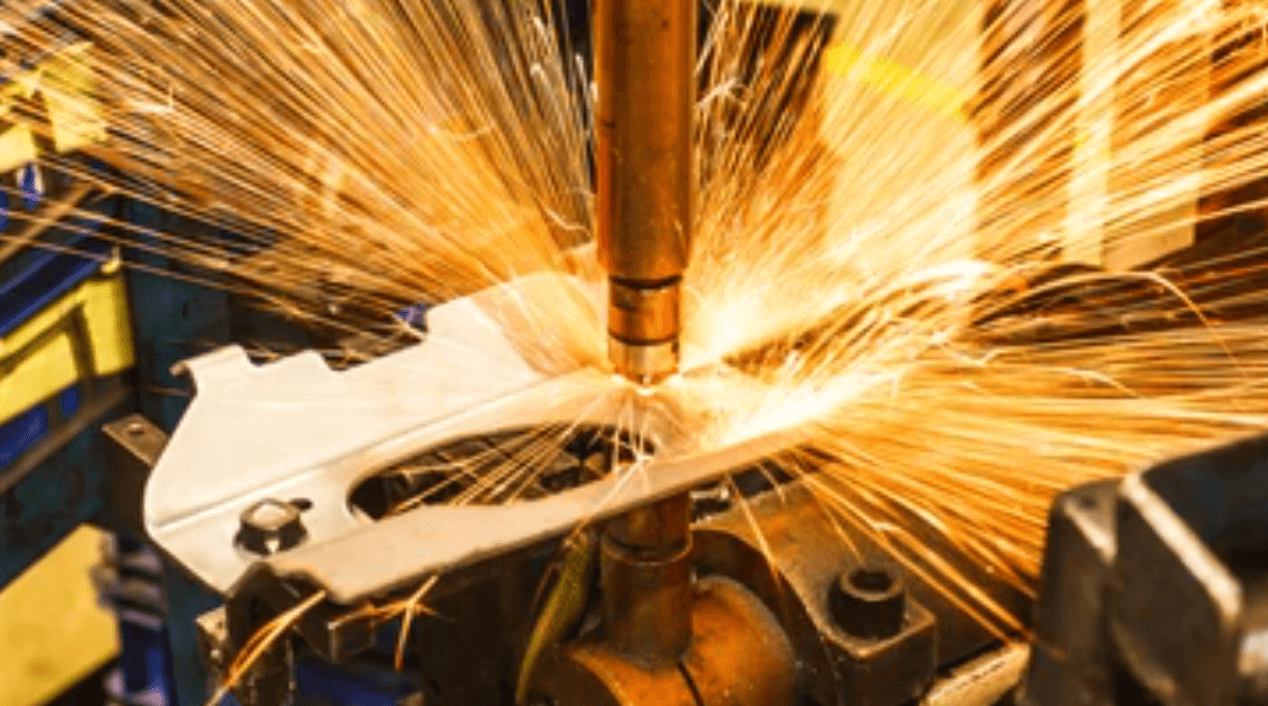
In resistance welding, the electrode tip is where all the action happens – it’s the critical interface between the welding equipment and the workpiece that determines weld quality, consistency, and production efficiency.
 
Traditional copper-only electrodes face significant challenges when welding highly conductive materials like copper, brass, and precious metals. These electrodes often suffer from sticking to the workpiece, rapid deformation under high current loads, and disappointingly short lifespans that lead to frequent production interruptions. 
 
This is where tungsten, molybdenum, and advanced alloy resistance welding electrodes revolutionize the welding process. Tungsten and molybdenum resistance welding electrodes are specifically chosen for their extraordinary performance in high-temperature, high-current welding applications, offering solutions that traditional copper electrodes simply cannot match.


The Core Materials for Resistance Welding Electrodes

Pure Tungsten (W)
 
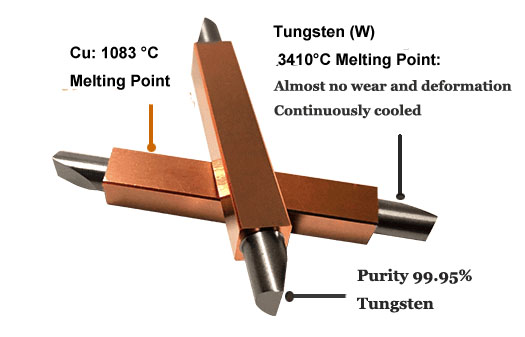
Pure tungsten electrodes represent the gold standard for extreme welding conditions. With a melting point of 3,422°C – the highest of all metals – tungsten maintains exceptional heat resistance and hardness even under the most demanding welding scenarios. According to industry standards, tungsten electrodes achieve a hardness rating of 70A on the RWMA scale while maintaining 32% IACS electrical conductivity.
What makes tungsten particularly valuable is its ability to resist deformation when welding copper, brass, and highly conductive alloys.
 
These materials generate minimal heat through electrical resistance, requiring electrodes that won’t soften or wear under high current densities. Tungsten’s low reactivity with most metals being welded promotes superior weld quality and dramatically extends electrode life.
 
Key applications include:
  • Electronics manufacturing for precise component joining
  • Battery connector welding in automotive and consumer electronics
  • Aerospace components requiring high-reliability joints
  • Medical device fabrication where consistency is critical

Pure Molybdenum (Mo)

 
Molybdenum offers an attractive balance of performance and cost-effectiveness. While slightly lower in melting point than tungsten (2,623°C), molybdenum still provides excellent high-temperature strength and thermal stability. Its RWMA hardness rating of 90B, combined with 31% IACS electrical conductivity, makes it highly suitable for precision resistance welding applications.
 
One of molybdenum’s key advantages over tungsten is its superior machinability. Unlike tungsten, which can only be ground or sharpened, molybdenum electrodes can be easily machined into custom shapes, making them ideal for specialized welding geometries and complex joint configurations.
 
Molybdenum excels in:
  • Precision spot welding of small components
  • Small-scale copper alloy joining operations
  • Applications requiring custom electrode geometries
  • Cost-sensitive operations where performance cannot be compromised

Advanced Alloys for Higher Performance
Lanthanated Tungsten (WL10, WL15, WL20)

 
Lanthanated tungsten represents a significant advancement in electrode technology. By adding small amounts of lanthanum oxide (typically 1-2%), we achieve improved arc stability, reduced contamination, and the ability to maintain sharper electrode tips throughout extended use cycles.
 
The lanthanum addition enhances the electrode’s recrystallization temperature and improves work function characteristics, resulting in more consistent welding performance and longer service life. This makes La-W electrodes particularly valuable in high-precision applications where repeatability is paramount.
 
Industrial applications include:
  • Fine spot welding in electronics manufacturing
  • Aerospace sensor assembly and testing
  • Battery pack manufacturing where consistent joints are critical
  • Precision medical device welding

TZM (Titanium-Zirconium-Molybdenum Alloy)
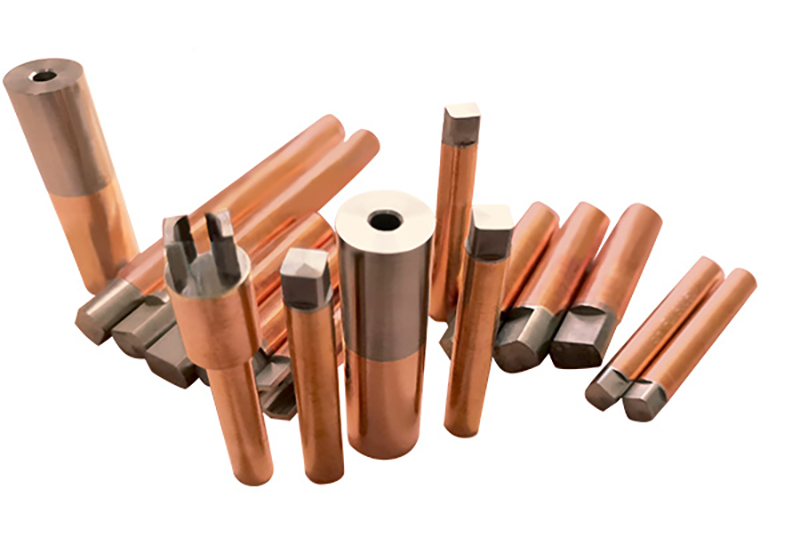
 
TZM alloy represents the pinnacle of molybdenum-based electrode technology. By strengthening the molybdenum matrix with titanium and zirconium carbides, TZM electrodes achieve superior creep resistance and dimensional stability under high mechanical loads.
This advanced alloy maintains its strength and shape integrity at temperatures up to 1,600°C, making it indispensable for heavy-duty welding operations. The enhanced mechanical properties translate directly into longer electrode life and more consistent weld quality, even under the most demanding production conditions.
TZM electrodes are essential for:
  • Heavy-duty projection welding operations
  • Aerospace and defense applications requiring extreme reliability
  • High-performance automotive parts manufacturing
  • Industrial applications with high-current, high-force requirements


Lanthanated Molybdenum (La-Mo)

 
Lanthanated molybdenum combines the cost-effectiveness of molybdenum with enhanced performance characteristics. The lanthanum addition improves the recrystallization temperature and wear resistance while maintaining balanced electrical conductivity and mechanical durability.
 
This material offers an optimal compromise between performance and cost, making it attractive for high-volume production environments where electrode longevity directly impacts operational efficiency.
 
Key applications include:
  • Electronics packaging and assembly
  • Medical device manufacturing requiring precise, clean welds
  • Precision aerospace welding where consistency matters
  • High-volume automotive component production

Why Choose Inserts Instead of Solid Electrodes?

 
The engineering behind electrode inserts represents a perfect marriage of materials science and practical economics. By combining a copper alloy body for optimal electrical conductivity with tungsten or molybdenum inserts for durability, we achieve performance that exceeds either material alone.
 
Advanced bonding techniques such as NDB (direct bonding) create metallurgical joints between the refractory insert and copper holder, ensuring excellent electrical continuity while maximizing heat dissipation. This design approach delivers several critical advantages:
 
  • Extended electrode life: Inserts can last 5-10 times longer than solid copper electrodes
  • Reduced downtime: Fewer electrode changes mean higher production efficiency
  • Consistent weld quality: Stable tip geometry throughout the electrode’s service life
  • Lower total cost: Despite higher initial investment, inserts reduce long-term operating costs

Industry Applications at a Glance
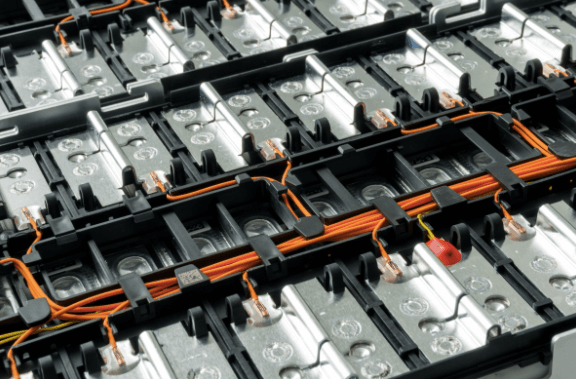
Electronics & Battery Manufacturing:
 
 
Lanthanated tungsten and lanthanated molybdenum electrodes provide the precision and repeatability essential for modern electronics. Battery pack manufacturing, in particular, demands consistent joints that can handle thermal cycling and mechanical stress.
 
 
Aerospace & Defense:
 
 
TZM and lanthanated tungsten electrodes meet the extreme performance requirements of aerospace applications. These industries cannot tolerate joint failures, making electrode reliability a critical safety factor.
 
Automotive:


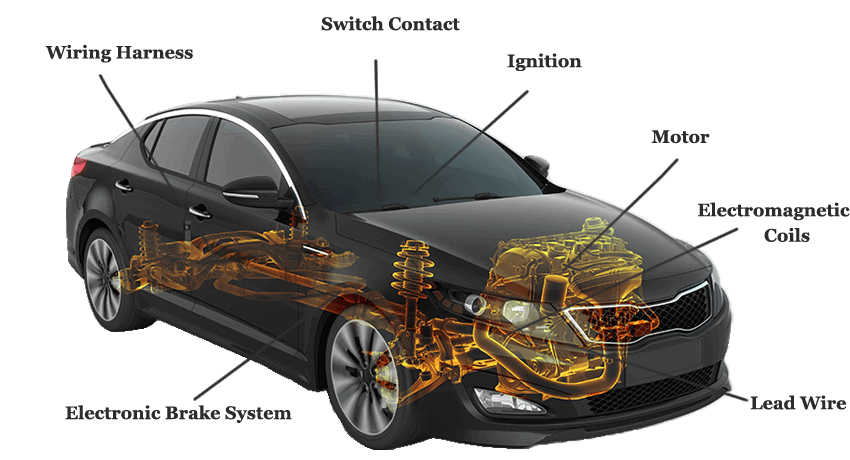
TZM and molybdenum electrodes handle the high-volume welding of copper and brass components in automotive electrical systems. From wiring harnesses to electric vehicle battery connections, these materials ensure reliable performance.
 
Medical Devices & Precision Fabrication:
 
 
Lanthanated molybdenum and lanthanated tungsten electrodes provide the consistent, precise welds required for medical device manufacturing, where joint integrity can be a matter of life and death.


Key Benefits of Tungsten and Molybdenum Alloy Inserts
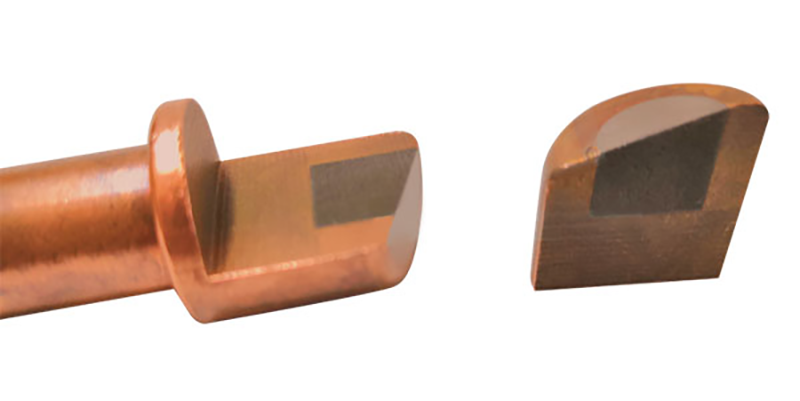
Interior Cross Section of NDB Insert Technology by Yolo

The superior performance of tungsten and molybdenum alloy electrodes stems from their unique combination of physical and chemical properties by NDB insert technology. The  These materials resist sticking and deformation when welding copper and brass, maintaining sharp tip geometry that’s essential for accurate, repeatable welds.
 
Their ability to withstand extreme heat and pressure without significant dimensional change ensures consistent electrode performance throughout extended production runs. This stability translates directly into improved weld consistency, enhanced reliability, and superior overall weld quality that meets the most demanding industrial standards.
 
According to industry data, these advanced electrode materials can improve weld quality metrics by 30-50% while reducing electrode replacement frequency by up to 80% compared to traditional copper-only alternatives.


Partner with Yolo Materials Industry Co.,Ltd
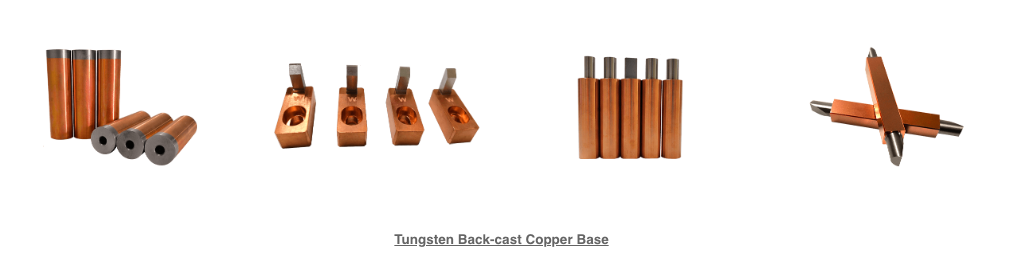
At Yolo Materials Industry Co.,Ltd, we bring decades of expertise in manufacturing high-performance tungsten, molybdenum, La-W, TZM, and La-Mo electrode inserts. 
 
NDB (non-defective bonding) electrodes are created using a high-vacuum bonding technique that forms a seamless joint—no filler materials, no voids, no weak points. Using copper, CuCrZr as shaft, tungsten, molybdenum, WLa, TZM etc as tips. This method produces a highly conductive, ultra-strong bond with tensile strength > 120MPa.


Yolo NDB Electrode ,Your Resistance Welding Solutions


At Yolo, we are dedicated to helping manufacturers achieve the highest standards in battery tab welding. Our NDB electrode solutions feature:

  • Custom Geometries: Tailored tip shapes for cylindrical, prismatic, and pouch cell formats.
  • Rigorous Quality Control: Every electrode is inspected for bonding strength, surface finish, and dimensional accuracy.
  • Technical Support: Our engineering team works closely with clients to optimize electrode selection and welding parameters for their unique applications.


Materials Options

  • WL10 (1% Lanthanated Tungsten): Good heat resistance and longer life.

  • WCu (Tungsten-Copper Alloy): Balances high strength and good conductivity.

  • TZM (Titanium Zirconium Molybdenum): Stronger and more stable than pure molybdenum.

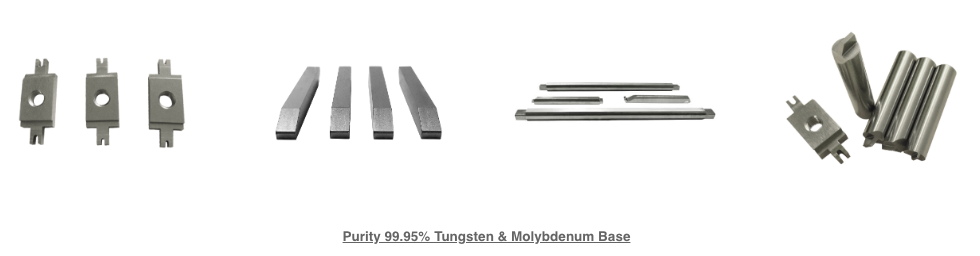
  • Pure Tungsten (99.95%): Excellent shape retention at extreme heat.

  • Pure Molybdenum (99.95%): Good thermal conductivity and lighter than tungsten.

Copper Bases (Heat Dissipation & Conductivity)

  • CuCrZr (Chromium Zirconium Copper): Strong and resistant to softening.

  • OFC (Oxygen-Free Copper): High purity and excellent conductivity.

  • Pure Copper: Cost-effective with good electrical and thermal performance.

Why Choose Us?
1. Cutting-Edge NDB Technology

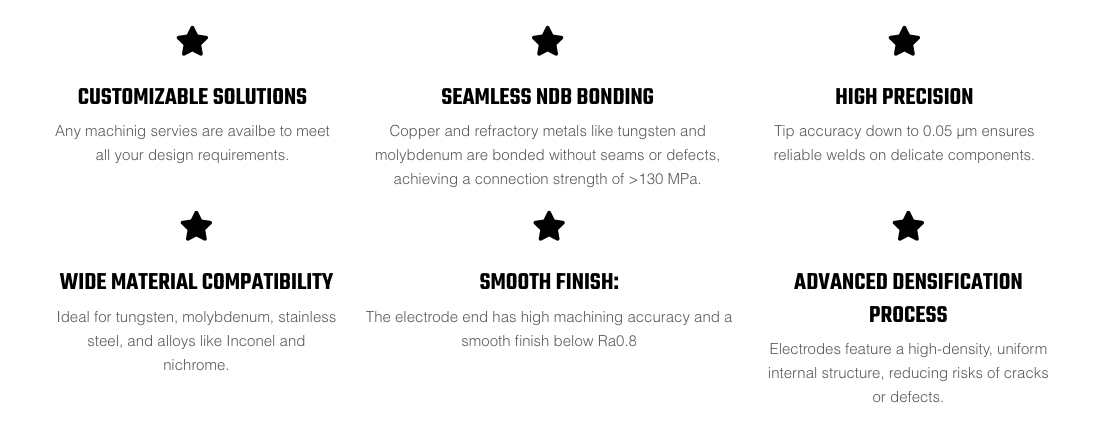
Our electrodes are built using advanced NDB bonding, delivering flawless copper-to-tungsten/molybdenum joints. This technology ensures exceptional durability, minimal defects, and consistent welding performance—even in high-production environments.

2. Precision That Sets Us Apart

With a machining tolerance of ±0.005 mm, every electrode is crafted to deliver repeatable, high-quality welds. No compromise on accuracy means fewer adjustments and better efficiency on the production line.

3. Our Own Raw materials

Our own raw materials produced, tungsten and molybdenum realted alloy tips, such as WL10, TZM, for heat resistance and shape retention, combined with copper bases that provide superior conductivity and cooling. This balanced design prolongs electrode life.

4. Expertise You Can Trust

Backed by years of experience in automotive, electronics, and battery welding, we know what matters: reliable performance, minimal downtime, and repeatable results.

5. Tailored Solutions

From custom shapes and sizes to specialized material combinations, we work closely with clients to deliver electrodes built for their exact requirements.

6. Quality Above All

Every product undergoes strict quality control—ensuring the electrodes you receive are ready for high-demand environments and deliver consistent weld integrity.

Yolo’s NDB electrode solutions empower manufacturers to achieve higher productivity, lower costs, and uncompromising battery quality. For tailored recommendations or to request samples, contact our technical team and experience the difference advanced electrode technology can make in your production line.

Contact Yolo for expert advice, custom solutions, or sample requests. Let’s build the future of EV battery manufacturing together!

YOLO

Top Grade NDB Resistance Welding Electrode
Factory Direct Supply

Get premium NDB electrodes with tungsten, molybdenum, WL10, and TZM alloy tips—directly from our factory in China. We offer OEM/ODM support, custom designs, and competitive pricing to meet your production needs.

  Your contact person
close slider